
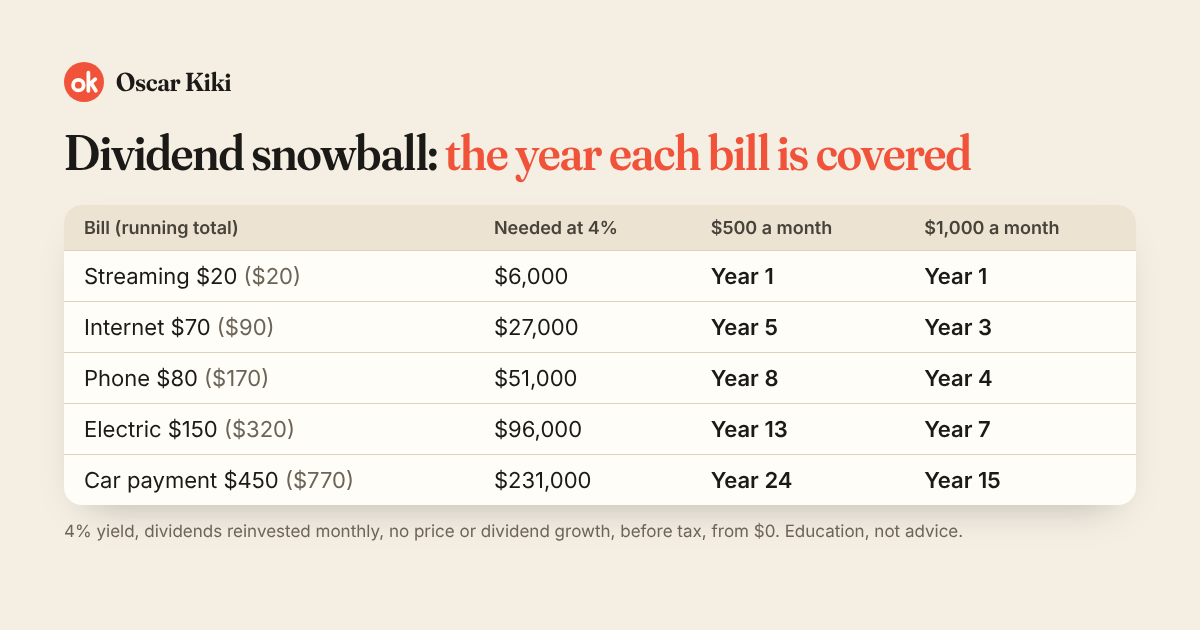
A dividend snowball is what happens when you reinvest your dividends. They buy more shares, the new shares pay dividends of their own, and your income grows faster than your contributions alone would grow it. Here is a worked example from our own model: $500 a month at a 4% yield, and the month each of five common bills becomes covered, smallest first.
The assumptions
Every number below comes from a simple month-by-month model. This is everything it assumes:
- You start from $0 and invest the same amount on the first day of every month: $500 in the main example, $1,000 in the second column.
- The yield is 4% a year, paid monthly (one twelfth of 4% of the balance each month) and reinvested the same day.
- No price growth. The share price never moves, up or down.
- No dividend growth. Each share pays the same dividend every year.
- Figures are before tax, with no fees.
- Bills are covered smallest first, and each one stacks on the ones before it. Internet counts as covered when one month's dividend pays internet and streaming together.
Most US dividend stocks pay quarterly, not monthly. We ran the model with quarterly payments too, and no date in the table moved by more than two months.
When each bill is covered
The running total is what one month's dividend has to pay. The amount needed is that total × 12 ÷ 4%, the same formula behind the full table from $100 to $10,000 a month.
| Bill | Monthly | Running total | Needed at 4% | At $500 a month | At $1,000 a month |
|---|---|---|---|---|---|
| Streaming | $20 | $20 | $6,000 | Year 1 (month 12) | Year 1 (month 6) |
| Internet | $70 | $90 | $27,000 | Year 5 (month 50) | Year 3 (month 26) |
| Phone | $80 | $170 | $51,000 | Year 8 (month 88) | Year 4 (month 48) |
| Electric | $150 | $320 | $96,000 | Year 13 (month 149) | Year 7 (month 84) |
| Car payment | $450 | $770 | $231,000 | Year 24 (month 281) | Year 15 (month 172) |
Before tax. 4% yield paid monthly and reinvested, flat share prices, flat dividends, starting from $0.
Year by year at $500 a month
Year 1: streaming. You put in $6,000 and the dividends add $132. The dividend paid in month 12 is $20.37, so the $20 streaming plan is covered at the end of the first year. At this point, dividends are only 2% of the balance.
Years 2 to 5: internet. Adding internet raises the target to $90 a month, which takes $27,000. You reach it in month 50, after putting in $25,000. Reinvested dividends ($2,245 by then) cover the rest, which is 4 months sooner than saving $27,000 from contributions alone.
Years 6 to 8: phone. The phone bill takes the target to $170 a month and $51,000. It's covered in month 88. You've put in $44,000, dividends have added $7,205 (14% of the balance), and the snowball is now 14 months ahead of contributions alone.
Years 9 to 13: electric. Electric brings the target to $320 a month and $96,000. It's covered in month 149, after $74,500 of contributions. Dividends have added $22,103, or 23% of the balance, and you're 43 months ahead of contributions alone.
Years 14 to 24: the car payment. The $450 car payment is the big jump: the target goes to $770 a month and $231,000. In year 18, the dividends reinvested during the year ($6,089) pass the $6,000 you add yourself, and from then on they add more each year than you do. The car payment is covered in month 281, in the fifth month of year 24. By then you've put in $140,500 and dividends have added $92,397, which is 40% of the balance. Saving $231,000 from contributions alone would take 462 months, about 38 and a half years.
The same $500 goes in every month, but the monthly dividend rises faster each year. It goes up by $21 during year 2 and by $49 during year 23. That growing gap is the snowball.
What changes at $1,000 a month
Doubling the contribution brings every bill closer, but the later bills don't come twice as fast. Streaming takes 6 months instead of 12, and the phone bill 4 years instead of 7.3. The car payment takes 14.3 years instead of 23.4, which is 61% of the time rather than half. The $500 plan runs longer, so its dividends have more time to compound: when the car payment is covered, dividends make up 40% of its balance and 26% of the $1,000 plan's. The faster plan also puts in more of its own money, $172,000 against $140,500.
If dividends grow 5% a year
Change one assumption: each share's dividend rises 5% once a year, and the price still stays flat. At $500 a month, streaming is still covered in year 1, internet moves to year 4, the phone bill to year 6, electric to year 9 and the car payment to year 14, ten years sooner than with flat dividends. At $1,000 a month the car payment moves from year 15 to year 10. A rising dividend on a flat price means the yield on every share climbs, from 4% to about 7.5% by year 14, and that flatters the result. If the price also rises 5% a year, new money keeps buying at a 4% yield, and the car payment is covered in year 17 at $500 a month and year 12 at $1,000.
Taxes
All the figures above are before tax. Dividends in a Roth IRA aren't taxed. In a taxable account, qualified dividends are taxed at 0%, 15% or 20%, depending on your taxable income, and IRS Topic 409 lists the income limits for each rate. Other dividends are taxed as ordinary income.
Tax slows the snowball in two ways: less money gets reinvested, and each bill needs a bigger dividend before tax to pay it. With 15% paid out of every dividend, the car payment moves from year 24 to year 28 at $500 a month, and from year 15 to year 17 at $1,000.
Run it with your own numbers
Your bills and your yield won't match ours. The free dividend income calculator shows how much you'd need invested to pay any monthly bill at the yield you choose, and estimates how many years it takes from what you have invested now.
If you already hold dividend stocks or funds, the Dividend Paycheck Planner has a 30-year snowball tab that starts from your current portfolio value and yield. For each year it shows your contributions, dividends before and after tax, the amount reinvested, price growth, the year-end value, and your monthly paycheck after tax as a percentage of your monthly goal. You can change the monthly contribution, the dividend growth rate and whether you reinvest. Unlike the model in this note, it includes price growth and tax.
A bill stays covered only while the dividend is paid
Every date above assumes the dividend keeps coming. A cut pushes every date back. Before you count on a stock's dividend, run it through the free 7-point dividend safety checklist.
General education, not investment advice. These numbers come from a simple model and are an illustration, not a forecast.
This note is general education, not investment, tax or legal advice. Past dividends don't guarantee future dividends. Examples are illustrations, not recommendations.